
Dry Tortugas National Park: First-Trip Guide
Plan with current information. Conditions, roads, services, fees, and rules can change. Verify details with the National Park Service before your visit.
Dry Tortugas National Park is not a park you casually “swing by.” Nearly 70 miles west of Key West, this 100-square-mile national park is mostly open water, with seven small islands rising out of unusually clear blue surroundings. The payoff is a visit that feels wonderfully separate from the rest of the Florida Keys: Fort Jefferson’s massive brick walls, reef-fringed water, marine life, and a bird-rich setting all share the same compact, remote landscape. For a first trip, the key is not trying to do everything—it is choosing the access method and pace that let you enjoy the place without turning the logistics into the whole story.
Why Dry Tortugas feels different from other national parks
The journey is part of the visit. There are no roads connecting Dry Tortugas National Park to the mainland or the Keys. The park is accessible only by a daily concession ferry, private boat, charter boat, or seaplane, so your transportation choice determines how much time you have on the islands, how much flexibility you retain, and what kind of day you will have.
This is a water park in the broadest sense. Most of the park is open water rather than land, and its reputation rests on the combination of historic Fort Jefferson, coral reefs, marine life, and bird life. A first visit works best when you think in layers: spend time understanding the fort, then give yourself unhurried time to look outward—from the shoreline, over the water, and toward the sky.
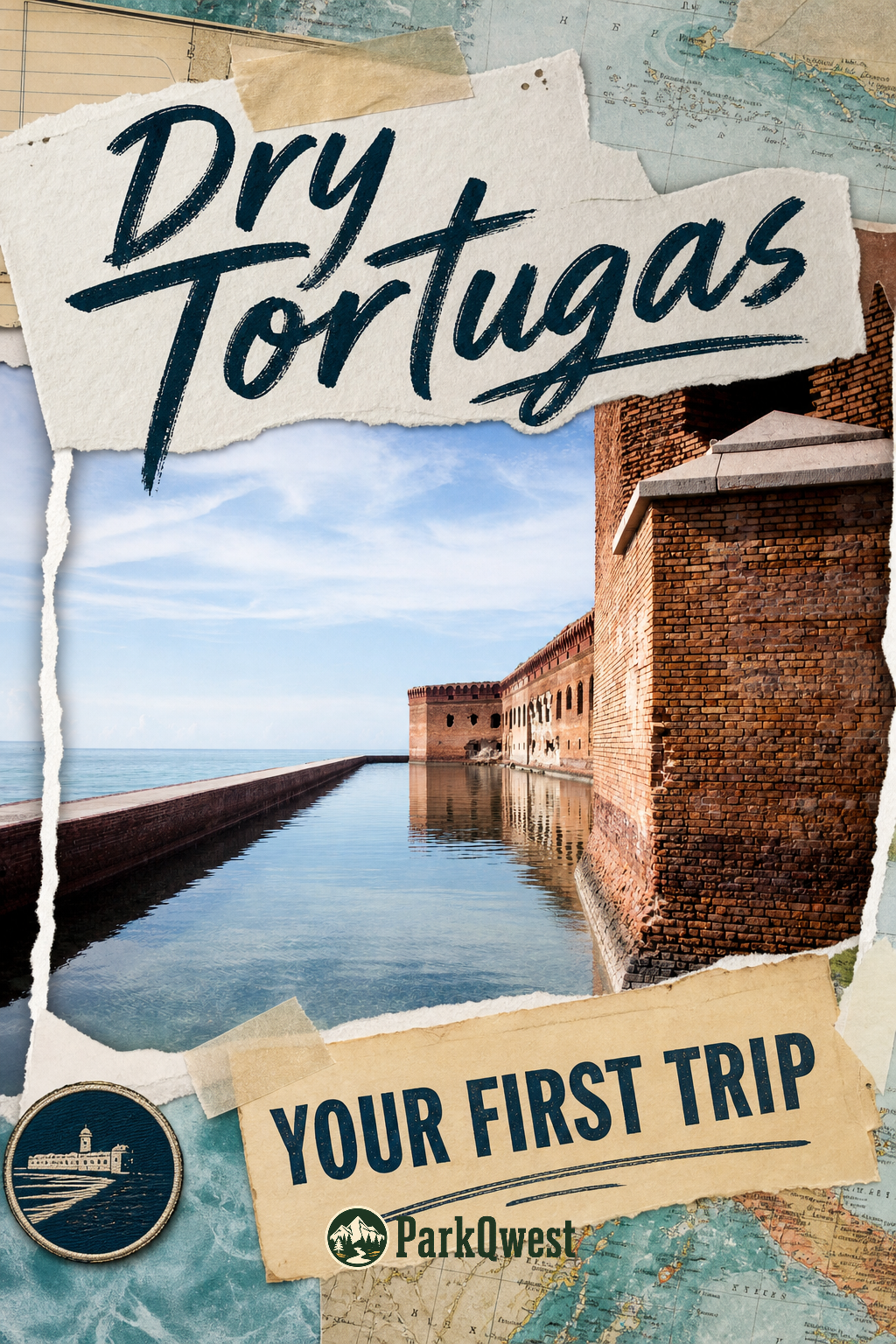
The visual contrast is a major part of the appeal: pale fort walls and brickwork, open horizon, intensely blue water, and very little of the visual clutter that comes with developed destinations. That makes Dry Tortugas a strong “save this for later” park, but it also means the practical details deserve attention before you commit to a date.
Quick take
Treat Dry Tortugas as a destination day, not an add-on to a busy Key West schedule. Your access method, weather conditions, and available time on the islands will shape the experience more than a long checklist of sights.
Start with the transportation decision
There is no universally best way to reach the park. The daily concession ferry is the most straightforward option for many first-time visitors because it provides a defined structure. A seaplane can appeal to travelers who prioritize a shorter transit experience and aerial views. Private boats and charters can offer more control, but they also place more responsibility on the traveler or operator for timing, sea conditions, and park-day logistics.
| Access option | Best fit for | First-trip tradeoff |
|---|---|---|
| Daily concession ferry | Visitors who want a clear, organized day | A long water crossing can feel significant if seas are rough |
| Seaplane | Visitors who value speed and an aerial perspective | Your time on the ground may be more limited; confirm the current trip format |
| Private boat or charter | Experienced boaters or travelers arranging a custom outing | More planning responsibility and stronger dependence on marine conditions |
Book the transportation before building the rest of the trip around it. Because access is limited and weather can affect marine travel, avoid treating the park as the final loose item on a Key West itinerary. Check the official NPS page and the current operator information for reservations, departure details, what is included, cancellation policies, and any current park alerts.
Where to base yourself
Key West is the natural logistics hub for a first visit. Dry Tortugas lies approximately 70 miles west of Key West, and the park’s access options are tied to reaching the water from the Keys. For practical planning, schedule your park day so you are not relying on a complicated same-day transfer from elsewhere in Florida before an early departure.
If your schedule allows, leave your Key West plans flexible on the day before and after the park visit. That is not because the park requires a multi-day itinerary; it is simply a smart buffer around a remote, weather-dependent excursion.
How to orient yourself once you arrive
Do not rush straight into the water or immediately begin circling the fort. Take a few minutes to get oriented to the island layout, current conditions, designated visitor guidance, and the time you need to be back at your transportation. The park’s scale can look simple at first glance, but a little orientation helps you use a limited visit window well.
Then divide the visit between the park’s two core experiences: Fort Jefferson and the surrounding marine environment. The fort provides the historical and architectural anchor. The water, reefs, marine life, and bird activity provide the sense of place that photographs alone cannot convey.
- Begin with the fort: Walk slowly enough to notice the scale of its construction, views through openings and arches, and how completely the structure dominates the small-island setting.
- Reserve time for the shoreline: Conditions, comfort level, and operator timing should determine whether your water time is a quick look or a central part of the day.
- Look up as often as you look down: The park is known for its assortment of bird life, so the experience is not limited to the fort or the reef.
- Save a quiet final stretch: Before departure, pause for the wide-water view rather than spending every minute in motion.
Quick take
The best first-day formula is simple: orient first, explore Fort Jefferson with intention, spend meaningful time at the water, and leave room to absorb the setting. Trying to maximize every minute usually makes this remote park feel smaller than it is.
Set a realistic pace for a one-day visit
Dry Tortugas rewards attention more than speed. First-timers sometimes assume a compact island means a quick visit. In reality, the transit itself is substantial, the fort is worth more than a fast pass-through, and water activities are naturally slower because conditions and comfort levels matter.
A useful mental model is to choose one “main” emphasis and one “supporting” emphasis. If the fort is your main focus, give yourself time to explore its scale and viewpoints, then enjoy the water and bird life without trying to turn the day into a full marine agenda. If the water is your main focus, still allow enough time to understand why Fort Jefferson is the park’s defining landmark.
A practical first-visit day
- Before departure: Recheck the official NPS page, current weather forecast, marine conditions, and the instructions from your ferry, seaplane, charter, or boat operator.
- During the crossing: Set expectations for the day rather than packing it with tasks. If you are sensitive to motion, plan for the possibility of rougher water, particularly during the winter stormy season.
- On arrival: Confirm your return time, review any current guidance, and take in the overall setting before committing to an activity sequence.
- First major block: Explore Fort Jefferson while your attention is fresh. Focus on its structure, setting, and views rather than trying to document every corner.
- Second major block: Spend time experiencing the water environment in a way that matches current conditions and your comfort level.
- Final block: Take a slower shoreline or fort-side walk, watch for birds, and return to your transportation with time to spare.
Common first-timer mistakes to avoid
- Underestimating the crossing: The park is remote by design. A boat trip across open water is not the same as a short harbor cruise, especially when winds and seas are up.
- Planning only for Fort Jefferson: The fort is essential, but the park’s identity also comes from reefs, marine life, water color, and bird life.
- Planning only for the water: Skipping the fort reduces the visit to a pretty-water stop and misses the landmark that makes Dry Tortugas distinctive.
- Ignoring the forecast category: NPS describes winter, from December through March, as windier and rougher at sea; summer, from June through November, brings hotter, more humid conditions and a higher chance of isolated tropical storms.
- Assuming conditions are durable: Transportation procedures, reservations, water access guidance, and park alerts can change. Verify the details closest to departure through the official NPS page and your operator.
The right first visit is not necessarily the longest or most elaborate one. It is the one organized around the reality of a remote island park: arrive prepared, give Fort Jefferson and the water equal respect, and allow the open horizon to be part of the plan rather than just the background.
Before you go
- Review official alerts, closures, hours, and reservation requirements.
- Allow extra travel time and keep an alternate plan.
- Use official NPS information as the final authority.
Sources
- Dry Tortugas National Park — official National Park Service site — National Park Service, accessed 2026-10-15
Continue planning Dry Tortugas
Learn more about Dry Tortugas and find other helpful guides, trails, and trip information in the ParkQwest guide.
ParkQwest is a QwestLyfe Community.
QwestLyfe helps you track your lifelong bucket lists, collections, recipes, and the places you've been. Document your experiences, add notes and pictures, and share them with your friends — and the world.