
Great Smoky Mountains National Park: 3-Day Itinerary
Plan with current information. Conditions, roads, services, fees, and rules can change. Verify details with the National Park Service before your visit.
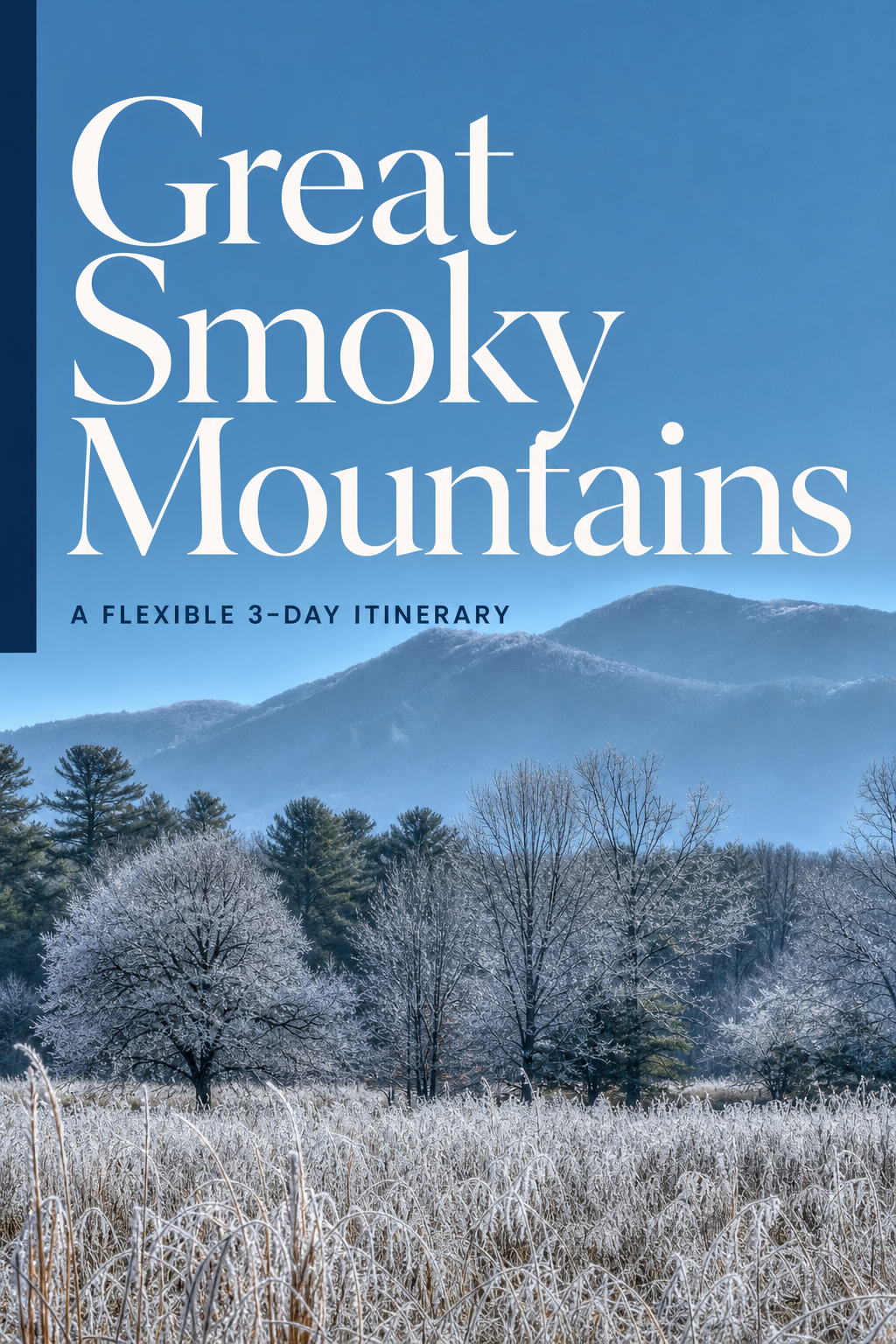
Great Smoky Mountains National Park is easiest to enjoy when you stop treating it like one long checklist. The park spans Tennessee and North Carolina, with main entrances near Gatlinburg, Townsend, and Cherokee, and its elevations run from roughly 875 to 6,643 feet. That means a three-day plan works best when each day has one clear job: learn the landscape at a lower elevation, devote a full day to the mountains, then use the final day for a quieter side of the park or a weather-smart reset. This itinerary is intentionally flexible; choose the entrance and lodging setup that fits your route, then confirm current road, trail, and weather conditions on the official NPS site before committing to any specific outing.
Quick take
Use Day 1 to get oriented, Day 2 for your biggest mountain objective, and Day 3 for the side of the park you have not yet experienced. Avoid building all three days around high-elevation views: mountain weather can differ dramatically from conditions at the base.
Before You Start: Choose a Base That Supports the Itinerary
The best gateway is the one that reduces the driving you actually want to do. Gatlinburg, Tennessee, is a natural fit if your trip begins on the Tennessee side and you prefer an active first day. Townsend, Tennessee, can make sense for travelers prioritizing a quieter approach. Cherokee, North Carolina, works well if you are arriving from the east or want to make the North Carolina side part of the trip rather than an afterthought.
Do not assume a point on one side of the park is a quick hop from the other. Mountain routes, traffic, weather, closures, and the kind of stops your group wants all affect the day. If you can change lodging once during a three-night trip, consider spending the first two nights near one side and the final night nearer the other; if not, treat the opposite side as an optional long-day excursion rather than an obligation.
- For early risers: Build your largest outdoor day around the clearest morning forecast, not necessarily the calendar’s middle day.
- For families or mixed abilities: Plan one primary walk or hike daily, then add a shorter backup only if energy, weather, and parking conditions cooperate.
- For photographers: Keep scenic overlooks and broad views as bonuses. Low clouds can erase a mountaintop view while making forests, streams, and historic landscapes more appealing.
- For drivers prone to motion sickness: Favor a shorter driving loop and more time outside rather than trying to cover every major corridor.
Day 1: Get Your Bearings on the Tennessee Side
Morning: Enter Slowly and Learn the Park’s Scale
Make the first morning a low-pressure orientation day, not a summit chase. Enter from the Gatlinburg or Townsend side if that matches your lodging, pick one currently open visitor information stop or official orientation resource, and look at the day’s conditions before choosing your route. The goal is to understand where you are headed, what elevations you will reach, and whether the park’s weather has changed the sensible plan.
Choose a lower-elevation walk, a short nature stop, or a historic-area visit listed by the NPS as open and suitable for your group. A modest first outing gives everyone a chance to test footwear, rain layers, snack needs, and comfort on mountain roads without spending the day recovering from an overambitious hike.
Afternoon: Pair One Outdoor Objective With a Cultural Landscape
Use the afternoon for contrast. Great Smoky Mountains National Park is known not only for its forests and biodiversity but also for remnants of Southern Appalachian mountain culture. Rather than stacking two demanding hikes, pair a forest or streamside outing with an open historic district, preserved structure area, or self-guided cultural stop identified on the official park website.
Pack lunch or plan to eat before entering the park, because a hunger-driven search for food can turn a pleasant afternoon into extra driving. Leave room for an unhurried return to your lodging: this is the day to buy groceries, organize gear, and set out tomorrow’s layers rather than trying to maximize mileage.
Evening: Build Tomorrow Around the Forecast
Check the forecast by elevation, not just by town. NPS guidance notes that temperatures can vary by 10–20 degrees Fahrenheit from mountain base to top, and clear skies at lower elevations do not guarantee pleasant conditions higher up. Choose tomorrow’s primary outing after dinner, then prepare a second plan that remains worthwhile if rain, fog, wind, or a closure changes the equation.
Alternate for Weather or Closures: The Low-Elevation Day
If higher roads, overlooks, or longer trails are unattractive or unavailable, keep your day close to the entrance you used. Focus on open lower-elevation walks, cultural sites, ranger-provided information, and a slower scenic drive only where conditions allow. This is not a failed park day; rainy forest conditions can make the park’s layers of vegetation and streams feel more immediate than a view-focused itinerary.
Practical pacing rule
On Day 1, stop while the group still has energy. A shorter first day protects Day 2, when you will want an early start, dry socks, charged phones, and no debate about where the rain jackets went.
Day 2: Give the Mountains Your Best Day
Morning: Start With the Day’s One Non-Negotiable
Reserve your clearest and strongest-weather window for one mountain-focused objective. That might be a longer hike, a high-elevation drive with stops, or a combination of one moderate walk and designated scenic viewpoints. Choose based on current NPS conditions, your group’s ability, and the amount of daylight available—not on a saved photo that makes a route look effortless.
Leave early enough that parking, weather changes, and photo stops do not compress your hiking window. Carry water, food, a warm layer, rain protection, and footwear appropriate for wet or uneven ground. The point is not to pack for every emergency; it is to avoid having a small weather shift force a major retreat.
Afternoon: Downshift Before Everyone Is Done In
Plan a deliberate energy break after the main outing. Eat lunch somewhere you can sit comfortably, refill water, and decide whether the group wants a second short stop or simply a scenic return. This is where many itineraries go wrong: a successful morning makes people add too much afternoon, then the final evening becomes rushed and tired.
If conditions remain good, choose a short, different kind of stop than the morning’s activity. After a hike, a scenic roadside pullout or cultural stop can feel restorative. After a drive-heavy morning, select an open walk that gets everyone out of the vehicle.
Evening: Keep Dinner Easy and Protect Recovery
Tonight should be your least complicated evening. Eat near your lodging or use groceries, dry damp gear, and review any soreness before selecting Day 3. If you have a laundry option, this is the practical time to use it; mountain trips are more comfortable when wet layers do not become tomorrow’s “clean” layers.
Alternate for Weather or Closures: Reverse the Day’s Priorities
If the high country is clouded in, windy, or affected by a closure, do not spend hours driving toward a view that may not materialize. Shift to a lower-elevation hike or cultural landscape, then use a short scenic drive in whatever area is open. Save the major mountain effort for Day 3 only if the updated forecast and your departure schedule genuinely support it.
Day 3: See the Other Side—or Take the Quiet Version
Morning: Choose Geographic Contrast
Day 3 is for the part of Great Smoky Mountains National Park your first two days did not cover. If you began from Gatlinburg or Townsend, consider entering from or exploring toward Cherokee, North Carolina, provided the current route and timing make sense. If you began from Cherokee, use this day to experience the Tennessee side. The value is not collecting entrances; it is noticing how the park’s ridges, forests, weather, and travel rhythm shift across the border.
If crossing the park would create a stressful travel day, choose the quiet version instead: revisit the side you already know, but select one open area with a different elevation, forest character, or cultural emphasis. A second look is often more rewarding than a rushed trans-park drive.
Afternoon: Make This the Flexible Finish
Keep the final afternoon intentionally light. Use it for a short walk, a scenic stop, picnic lunch, or an open historic area rather than another all-day commitment. This creates room for checkout, onward travel, weather delays, and the ordinary realities of a three-day trip.
Before leaving, do one final condition check if you are driving through mountain terrain. Weather in this park is shaped sharply by elevation and topography, so base-area sunshine should never be your only data point.
Evening: End With a Useful Note for Next Time
Rather than trying to “finish” the park, note what you would return for. Maybe it is a longer hike skipped for weather, a cultural area you only had time to sample, or the gateway you did not reach. Great Smoky Mountains National Park rewards repeat visits because its forests, mountain weather, and Appalachian landscapes do not present the same trip twice.
Before you go
- Review official alerts, closures, hours, and reservation requirements.
- Allow extra travel time and keep an alternate plan.
- Use official NPS information as the final authority.
Sources
- Great Smoky Mountains National Park — official National Park Service site — National Park Service, accessed 2026-08-27
Continue planning Great Smoky Mountains
Learn more about Great Smoky Mountains and find other helpful guides, trails, and trip information in the ParkQwest guide.
ParkQwest is a QwestLyfe Community.
QwestLyfe helps you track your lifelong bucket lists, collections, recipes, and the places you've been. Document your experiences, add notes and pictures, and share them with your friends — and the world.